Monday, July 12, 2010

Monday, July 12, 2010


Sunday was a travel day. We drove from Twillingate to Doyles. We were going to take two days, but decided to push it and have time to do some sightseeing around Port Aux Basques on Monday. We drove 592 km (355 miles). Toward the end of the day, we were driving in rain, and it was raining the worst when we got to the RV park. It hardly stopped raining all night.
Today we drove to Port Aux Basques and everything was solid fog. We went to the Rose Blanche lighthouse, and you can see that any hopes of a view of the ocean were gone.

On our way to the lighthouse, we stopped at The Ann Harvey Trail, an area memorializing the efforts of Ann and her Newfoundland dog that helped save the lives of 150 passengers on a ship that was sinking in a storm back in 1820. At the community center/interpretive center, I found out there was a boat being built in the basement. The photo shows a start of the project.
Tomorrow, we take the ferry back to Nova Scotia. Departure time is 8:30 A.M., and we have to be there 1 hour early. It's about a 30 minute drive in good weather, but tomorrow morning will probably not be "good" weather, so we are planning on taking 1 hour to get there. That makes for an early 'rise and shine' time.
P.S. The guys have been whooping the gals in bridge. Dave had 33 points in one hand and also bid and made a small slam bid. The gals haven't given up yet, though!


Saturday, July 10, 2010

Saturday, July 10, 2010


Twillingate, NL, is a typical fishing village with lots of interesting places for tourists to see. We started at the Anglican Parsonage, which is the local museum. Just across the street is St. Peter's Anglican Church. I think it's been a day or so since I showed you a picture of an Anglican church.


Our next stop was at Herring Neck, a beautiful little fishing village. We saw a fairly large fishing boat off-loading some crab pots, and we stopped to ask him some questions. His name was Jim King and, he was the owner of the boat. They were bringing in all their pots because Saturday will be the last day of the season. It will take three trips to bring in all the pots and line. When we were visiting they were off-loading 15 miles of rope which is used to connect the pots. He, Jim King, said that they might get 30 pounds of crab to a pot. They would like to get 45 pounds, but crabbing isn't that good right now. Below is a photo of a village near Main Tickle Bay.


The photo, above right, is of Twillingate Light House. The light house is being renovated and you can see they are working on the siding and windows. Mike Paterson is doing the windows and casings. He's the woodworker that we visited last Sunday. The work is being done to original spec's.


Thursday night, we went to a dinner theater in Crow Head. The group is called the Round the Circle, and they serve the meal and then do a show that is true Nufey humor. The jokes and skits are so stupid they are funny. The photo at the left is a take-off on Lilly Tomlin's.


When we checked in at the campground on Thursday, Connie mentioned that we knew of some people who lived in Twillingate, but had never met them. Les Smith told us that the Elliott's lived in Twillingate. The owner of the park knew the Elliott's and gave them a call. Later Sterling and Joan Elliott stopped at the campground and introduced themselves. We visited a while and they invited us to their home on Friday night, after the dinner theater. We enjoyed meeting them and had a very nice visit. They are pictured here in front of their beautiful home.


Today, we went to Prime Berth, photos above. The owner does the tours and talks about growing up in Tizzard's Harbour. His father was a cod fisherman. He demonstrated how the cod are cleaned and salted. The whale bones are from a actual whale that had died and washed up on a beach. He contacted the government agency and asked if he could have the carcass. He towed it quite a distance, let the flesh decompose, and then reassembled the bones for display.


The picture, upper right, is of fishing boats at Tizzard's Harbour.


This photo is to add a little humor to the blog. Yes, there is a Dildo Run Provincial Park.
We will continue to look for interesting points of interest.


Thursday, July 8, 2010

Thursday, July 8, 2010


Wednesday, we drove to Trinity/Bonavista Bay and spent the night in Les and Shirley Smith's driveway. The blog today is short on pictures and long on story.
When we were in Trinity/Trinity Bay on Tuesday, I asked several people if they knew Shirley Brown, Les' wife. Les told me that when I got to Trinity, all I had to do was ask and anyone in Trinity would know her. Both times I asked, neither knew of her, and I was told the Browns were all from Trinity East.
Later, after talking with Shirley, I was told they didn't live in "that" Trinity, they lived in the other Trinity. The Smith's live at Trinity/ Bonavista Bay. She had circled the correct Trinity on the Newfoundland map that Les gave me last winter, but I forgot to check that map because we had picked several other NL maps.
Anyway, we got to their home around 5:00 and had a great meal with Les and Shirley. Here's another example of wonderful Newfoundland hospitality!
Above is a photo of Les and Shirley. Look in the background! That's the Atlantic Ocean! The views from their home are fantastic. The photo above is of the group on their front deck. Connie and I know Les and Shirley as Winter Texans from Victoria Palms. I know I've said it before, but we are so fortunate to have such wonderful friends from South Texas.


Today we left Trinity and drove to Twillingate, NL to the Payton's RV Park. This will be our last major stop on the "Rock" before we head for the ferry next Tuesday.
The light house is the Long Point Light House. Imagine that, another light house.

Wednesday, July 7, 2010

Tuesday, July6, 2010


Saturday we left Pippy Park in St. John's and drove to the end of Bonavista Peninsula to a campsite call Paradise. The owner was very friendly and helpful in giving us information on what to see and do. We drove to Elliston and tried to get close to Puffins but only saw them at a distance. We then drove to the Cape Bonavista light house that you see above. We stopped at the local city park and saw another statue of John Cabot who landed here in 1497, notice the light house in the background. Then we drove to Dungeon Provincial Park. The park gets its name because the waves had cut two holes in the rocks and the earth above collapsed into the open area.


Sunday, the 4th was a very interesting day. We wanted to go back to Elliston and try to get closer to the Puffins. The early morning was foggy, very cool, and misting sometimes. We still chose to try getting closer to the Puffins. We walked back and found some Puffins very close. Before they were only across on an island. Sunday morning, they were on our side. I had the telephoto lens on (6X) and took over 140 pictures very close up. The one photo below shows them across on the rocks where they were nesting. The other two photos are the close-ups.

The next thing we did was tour the Ryan Premises National Historic Site in Bonavista. Ryan was a wealthy merchant in the late 19th century. He made his fortune off the cod fishing. The historic site is a museum about the cod fishing and the area. The photo at the bottom is of one of the statues in the museum.
We drove to Upper Amherst Cove looking for a woodworking business, Paterson Woodworking. We found the business and, luckily, Mike Paterson, the owner, was there on a Sunday afternoon. We had a great visit, and he gave us a tour of his shop, and we looked through his showroom. To me, that was an exciting part of the day.
We drove to Port Union and toured the Coaker Museum. Sir William Coaker built the town and opened a newspaper that published "The Fisherman's Advocate." Port Union is the only union built town in North America. The second floor of the museum still has a lot of the old belt-driven woodworking tools that were used in the early 1900's.


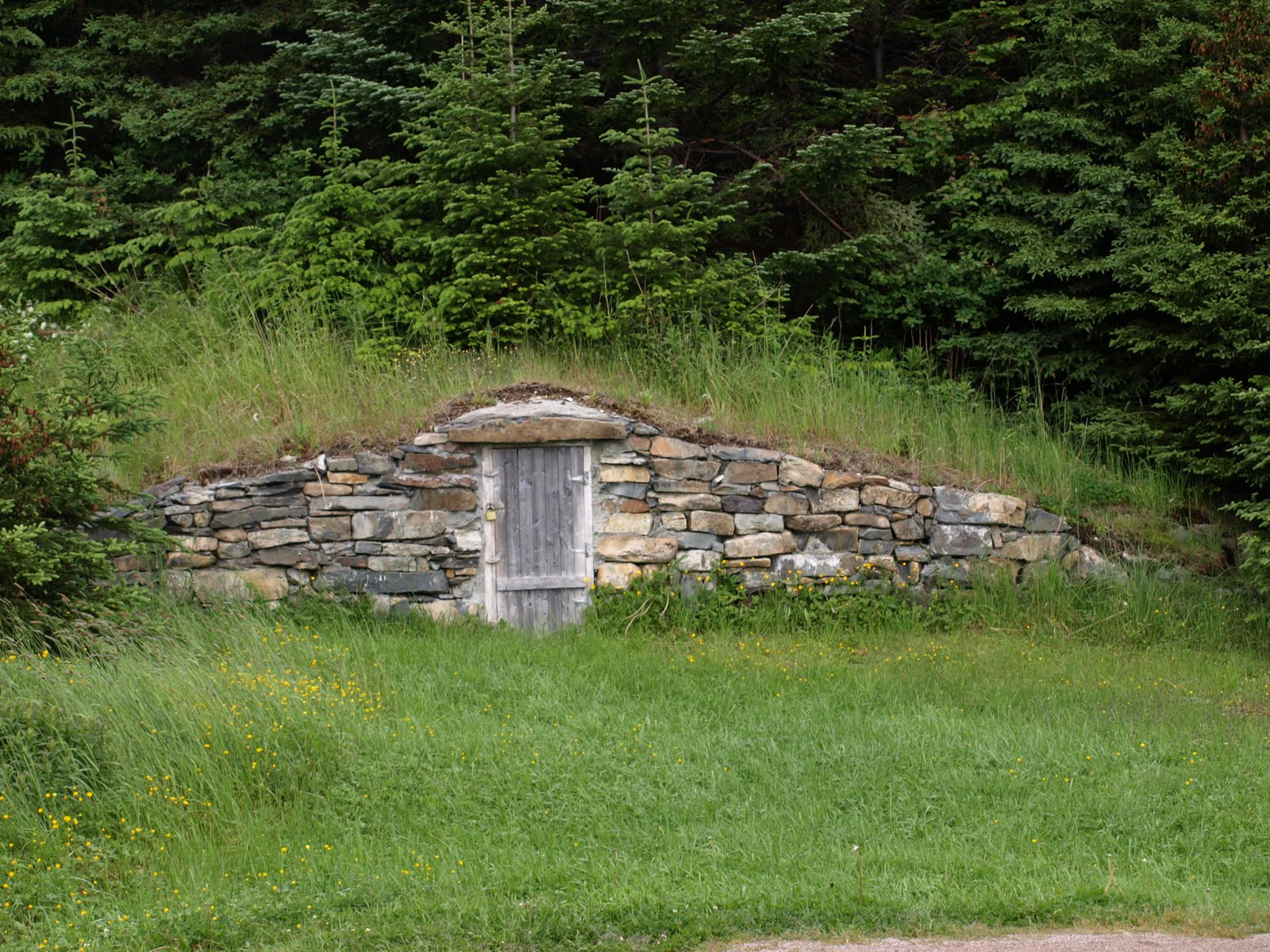
Elliston is also the root cellar capital of Newfoundland.


Monday we visited Trinity on Trinity Bay and did a walking tour of six different historic homes and shops. The piece of furniture to the right is original to one of the homes. It dates to the 1700's.


This Anglican church is in Trinity.


This photo is of a mussel farm near Trinity. The floats are holding ropes where the mussels are attached and growing. I understand that it takes two years for mussels to grow to maturity.


On Tuesday, we drove to Gander and visited the Silent Witness Memorial. The memorial is for the 254 American soldiers and crew that died when their plane crashed shortly after refueling in Gander. They were returning from a peace-keeping mission in Egypt.
We also visited the Newfoundland Aviation Museum in Gander.


Friday, July 2, 2010

Wednesday, July 1, 2010


Tuesday, we went south of St. John's on the Avalon Peninsula. We went whale and bird watching on the Molly Bawn, the fine boat you see pictured. At first I wasn't so sure that I wanted to go out in the ocean in that thing, but it was fine. The sea was fairly rough, but nobody got sick except for the fellow from China. We didn't see any whales, but saw lots of birds as you can see. We saw puffins, the common murres, kittiwakes, razor bills, a bald eagle, and gulls.


The area is the Mobile Witless Bay Ecological Reserve and you can see there are tens of thousands of birds on just this one island.


On the way back, we passed a small pond with many miniature boats (about 3 feet long) and a miniature of a fishing village. Whoever did it paid a lot of attention to detail. Connie wanted one for our pond at home.


On Wednesday, Canada Day, we went to Signal Hill National Historic Site. The Canada Day celebration in St. John's started here at 6:00 A.M. with a round of cannon fire. The Visitor Center was very well done and they had a nice film of the history of Signal Hill. It was first controlled by the French and then lost to the British. The building on the hill is called the Cabot Tower and was used by the British to signal what ships were coming into the harbor. It was also used by Marconi to send wireless messages to England.


Here is a panel about icebergs. You can double click the picture to enlarge it. Only about 370 of up to 40,000 glaciers that are produced in Greenland make it as far down as St. John's.


Here's a look at the St. John's harbor from on top of Signal Hill. From the sea, it would be hard to tell that there is a big harbor. It is well protected from the ocean. The harbor is huge. During WWI and WWII this harbor played a big part in shipping supplies to Britain.


Oh, lunch downtown at a micro brewery. Lunch seems to agree with Connie. It makes her happier.


We also had an opportunity to visit the oldest Anglican parish in North America. The parish started in 1699. It is now the Cathedral of St. John the Baptist. The stained glass pictured is the only glass that survived a fire. The piece of furniture I found interesting was the Bishop's chair you see pictured.


A beautiful church with a lot of history. We were given a tour by one of two ladies that volunteer their time to add some history for each visitor.